




































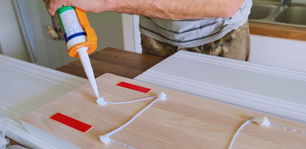




























































































Soils can be naturally hydrophobic, which can have a negative impact on water infiltration and the supply of water to the root zone, and consequently on crops. To remedy this, surfactants are used to moisten hydrophobic soils.
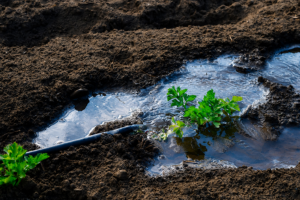
Wettability is a parameter characterising the behaviour of a material when it comes into contact with liquids. It is an extremely important property of soil, as it determines its agricultural suitability and indicates how it should be moistened in order to achieve the highest possible yields with the lowest possible water consumption.
The wettability of individual soil layers influences the distribution of water within the soil profile. In the case of hydrophobic soils with low wettability, there is a risk of water accumulating on their surface following heavy rainfall and causing surface runoff, which can lead to environmentally harmful water erosion of the soil. The consequences of this phenomenon include the leaching of nutrients, soil degradation and, in the longer term, a reduction in arable land.
The degree of soil wettability and water movement within the soil are influenced by its properties, such as chemical and granulometric composition, porosity, the proportion of clay and humus fractions, the amount of organic matter and minerals present, salinity, pH, as well as external factors: weather conditions, temperature, droughts, fires, soil contamination, fuel leaks from agricultural machinery and agrotechnical practices.
Surfactants in soil irrigation
Surfactants have traditionally been used in crop production and associated with various plant protection products. However, their global use in the agricultural sector has risen sharply due to their application as an additive to irrigation water.
Surfactants, acting at the interface between water and soil, reduce the surface tension of the irrigation water, allowing it to penetrate the soil more easily and moisten it. This has a positive impact on water use efficiency and, in the longer term, on crop quality, partly by reducing the leaching of nutrients and increasing their uptake by plants.
The PCC Group is responding to the demand for soil wetting agents by offering specialised blends of non-ionic surfactants – EXOwet R3823 and EXOwet R3831.
The soil’s ability to retain irrigation water
How effectively the soil retains water is crucial to how much moisture and nutrients actually reach the root zone, rather than running off or evaporating. This parameter largely determines the effectiveness of irrigation, fertilisation and the overall condition of the soil. The graph below compares the retention coefficients of various irrigation solutions in the soil:
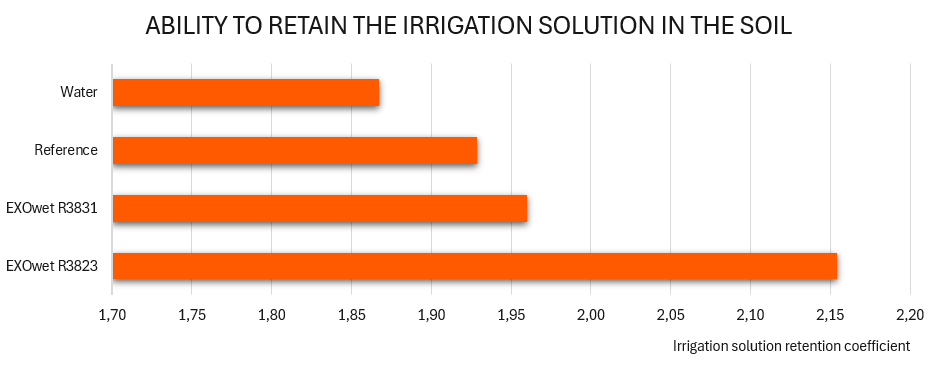
Figure 1 . Comparison of retention coefficients for wetting solutions.
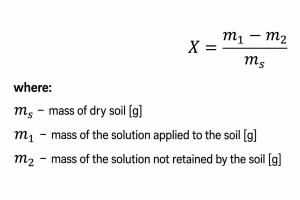
The test involved applying approximately 60 g of a wetting solution (water or a 1% solution of a suitable wetting agent) to approximately 20 g of dried universal potting compost and measuring how much of the solution was retained in the soil. The retention capacity of the individual irrigation solutions was compared using a coefficient calculated from the formula:
Moistening the root zone
The use of EXOwet R3823 and R3831 enables irrigation water to be retained in the upper soil layers. A simulation of this type of situation is shown in the video below. Sugar cubes mimic the macro- and microporous structure of the soil.
Video 1. Simulation of soil root zone wetting.
Water containing wetting agents is retained in the upper layers.
Each sugar cube was sprinkled with the same amount of irrigation solution (15 drops) and its movement deeper into the porous structure was observed. After a few seconds, it can be seen that water without additives flows instantly to the lower layer, whilst water with a 0.5% wetting agent additive is retained in the upper layer. This illustrates how water containing additives remains in the soil’s root zone, where it is much more readily available to plants compared to water without additives, which flows rapidly into deeper layers, thereby carrying the additional risk of leaching nutrients.
Wetting capacity by immersion
The wetting capacities of the EXOwet R3823 and R3831 products were compared with a reference standard and water as a control sample, also using the in-house method ‘Determination of wetting capacity by immersion’. For this purpose, standardised discs made of raw cotton knit fabric with a diameter of 30 mm were used. The determination involved measuring the wetting time, i.e. the time between immersing the cotton disc in a 0.5% solution and the moment it begins to sink. The results are summarised in the graph below:
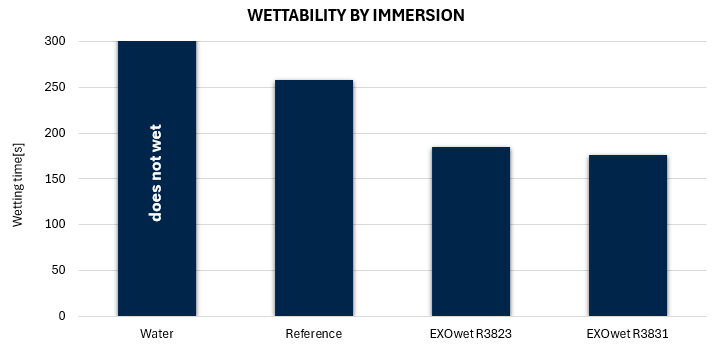
Figure 2 . Comparison of the wetting times of cotton discs by water (control) and 0.5% solutions of wetting agents.
EXOwet R solutions wet the cotton discs after only about 3 minutes, the control sample only after 4 minutes, whilst water without added wetting agents does not wet the discs even 2 hours after the start of the test. It is therefore clear that the addition of surfactants is essential for achieving satisfactory wetting properties.
Water retention in soil
Water retention in the soil is an extremely important phenomenon, as it increases the availability of water to plants and improves the soil’s resistance to drought. The use of wetting agents in irrigation significantly increases the soil’s water-holding capacity.
To illustrate the water-retention capacity of various irrigation solutions, a simulation was carried out again using sugar cubes. The photographs below show the low water-retention capacity without the addition of wetting agents:
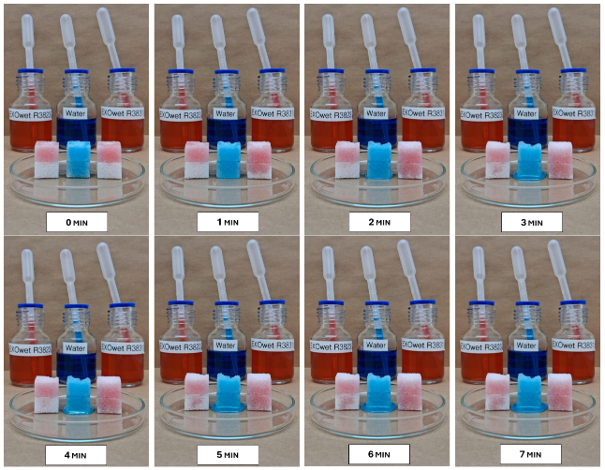
Figure 1. Water retention simulation. Water with a 0.5% wetting agent additive is retained much more effectively.
Each of the top sugar cubes was moistened with 25 drops of irrigation solution. After a few minutes, it was observed that the water without additives had almost completely drained from the porous structure, whilst the EXOwet R solutions were fully retained. This indicates that even a small addition of surfactants to water significantly increases the soil’s water-retention capacity. This is extremely important under real-world conditions, as rapid water flow through the soil profile can lead to the leaching of nutrients essential for plant growth.
Repeated irrigation treatments using EXOwet R3823 and R3831
Previous studies clearly show that irrigating the soil using wetting agent solutions is significantly more effective than using water alone.
The video below illustrates how repeated irrigation treatments using a 1% solution of EXOwet R3831 affect the rate of water absorption during subsequent irrigation cycles using water alone:
Video 2. Comparison of wetting rates depending on the number of treatments
using a 1% solution of EXOwet R3831.
The study used biodegradable peat pots simulating soil (soil organic matter), which were placed in dishes containing water without additives; pot 1 had not been pre-moistened with the EXOwet R3831 solution, pot 2 was moistened once with the EXOwet R3831 solution and then dried, whilst pot 3 was moistened twice with the EXOwet R3831 solution and then dried.
It can be observed that, after a few minutes, pot 1 is still not absorbing water; in pot 2, the rate of water absorption is moderate; whilst pot 3 is becoming saturated very quickly (complete saturation occurred after 10 minutes).
The conclusion from this experiment is as follows: pre-wetting the soil with wetting agent solutions results in increased and accelerated water absorption during subsequent irrigation treatments. This confirms the validity of carrying out multiple irrigation treatments using soil wetting agent solutions.
A similar study was carried out on actual soil samples. Containers with holes drilled in the base were filled with approximately 100 g of dried-out all-purpose potting compost; these were treated with water or 1% solutions of wetting agents and then dried. The containers with soil were then immersed in petri dishes containing plain water, and the time taken and the volume of solution absorbed were measured. The results are shown in the graph below:
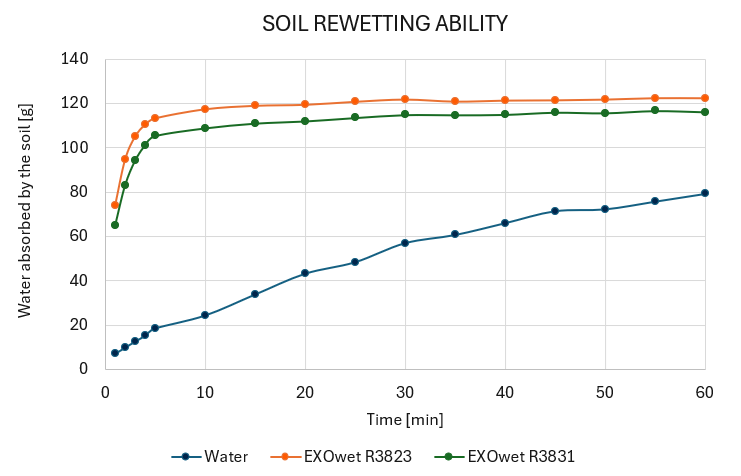
Figure 3. Comparison of the rate of wetting and the amount of water absorbed by soil previously moistened with various irrigation solutions.
It can be concluded from the study that the use of wetting agents as additives to irrigation water increases not only the total amount of water absorbed, but also the rate of absorption. Soil pre-moistened with EXOwet R solutions absorbs approximately 10 times more water in the first minute after watering than soil moistened with water alone. The maximum water uptake for EXOwet R is reached as early as around 10–15 minutes, whereas for water alone the increase in uptake is approximately linear; however, even after 1 hour, it is 1.5 times lower than for the wetting agents.
Summary
As can be seen from the research carried out, the use of surfactants, particularly those from the group of wetting agents, can produce significant, noticeable effects in the soil. The use of EXOwet R brings many benefits:
- Mitigating the negative effects associated with the soil’s hydrophobic nature.
- Rapid and uniform soil irrigation.
- Increased water availability for plant growth and agricultural production.
- Retention of water in the root zone.
- Prevention of adverse phenomena such as surface water accumulation, surface runoff and soil erosion.
- Overall improvement in soil health.
- I.E. Olorunfemi, T. A. Ogunrinde, J.T. Fasinmirin, Soil Hydrophobicity: An Overview, 2014.
- S.H. Doerr, R.A. Shakesby, R.P.D. Walsh, Soil water repellency: its causes, characteristics and hydro-geomorphological significance, 2000.
- A. Sochan, Zwilżalność gleby jako czynnik warunkujący pierwszą fazę erozji wodnej, 2021.
- Z.E. Tyszkiewicz, R. Czubaszek, S. Roj-Rojewski, Podstawowe metody laboratoryjnej analizy gleby, 2019.
- V. Baratella, M. Renzaglia, A. Trinchera, Effect of surfactant as adjuvant for irrigation/fertigation in vegetable production: Preliminary results on lettuce, 2016.