

















































































































Foam formation underlies many natural and industrial processes. This phenomenon plays an important role in both everyday applications and advanced technologies, influencing the efficiency and course of various processes. Understanding the mechanisms of foam formation and decay allows for better control of its properties and practical use.

Foam as a dispersion system
Foam is a colloidal system, specifically a particular type of dispersion in which the dispersed phase is a gas (usually air) and the dispersing (continuous) phase is a liquid or solid.
When gas bubbles are suspended in a liquid, a light, fluffy and malleable substance is formed. In most cases, this type of foam is temporary and returns to its original liquid state over time. However, if a stabiliser is added to the liquid, it can remain in a foamed state for much longer.
When gas bubbles are suspended in a solid, a light, spongy or rigid material is formed, which can be easily moulded into various shapes as required.
How is foam formed?
The formation of foam in liquids is a relatively complex physicochemical process and involves several stages:
- The first of these is the application of external mechanical energy to force gas bubbles into the liquid dispersing phase. This can be achieved, for example, through mixing, aeration or sudden changes in pressure. It is worth noting that the energy required to produce foam is inversely proportional to the surface tension of the liquid.
- Next, the difference in density between the liquid and the resulting gas bubbles causes them to move towards the surface of the dispersing phase.
- The final stage involves the formation of so-called lamellae. Thanks to these, the gas bubbles accumulated on the surface do not coalesce. Lamellae are very thin liquid films trapped between two layers of surface-active substances added to the system, such as surfactants.

What determines the stability of foam?
Foam is a thermodynamically unstable system, and the final stage is the rupture of a bubble following a reduction in the total liquid surface area in the system, which results in a decrease in free energy.
Several factors influence foam stability:
Surface tension. From an energy perspective, low surface tension is more favourable for foam formation, but does not guarantee its stability. When surface tension is low, the pressure difference is small, the outflow velocity decreases, and the liquid layer becomes thinner, which promotes foam stability.
Surface viscosity. A key factor determining foam stability is the strength of the liquid layer, which is mainly determined by the compactness of the adsorption layer on the surface, measured by surface viscosity.
Gas diffusion through the liquid layer. Due to the presence of capillary pressure, the pressure within small bubbles in the foam is higher than that in large bubbles. This causes gas to diffuse through the liquid layer. As a result, the small foam bubbles shrink and the foam eventually collapses.
The presence of surfactants. Thanks to their amphiphilic structure, which determines their coordinated arrangement in space, they stabilise the walls of the foam bubbles and promote the formation of new ones.
Foaming properties of surfactants
The formation of stable foam in pure liquids is significantly impeded. To achieve this, surface-active substances, known as surfactants, are used.
Surfactants can facilitate the formation and stabilisation of foam through several mechanisms:
- Reduction of surface tension: Surfactants reduce the surface tension of the liquid phase, facilitating the entrapment and dispersion of gas bubbles in the liquid, which leads to foam formation,
- Formation of an interfacial film: Surfactant molecules adsorb at the gas-liquid interface, forming a cohesive and viscoelastic film that surrounds the gas bubbles, preventing their coalescence and stabilising the foam,
- Dilatational elasticity: The interfacial film formed by surfactants exhibits dilatational elasticity, which allows it to prevent deformation and rupture, further enhancing foam stability,
- Electrostatic and steric stabilisation: Ionic surfactants can cause electrostatic repulsion between gas bubbles, whilst non-ionic surfactants can provide steric stabilisation by forming a protective layer around the bubbles.
It is worth remembering that not all surfactants will exhibit the same foaming capabilities. These depend on various factors, including, above all, the concentration of the surfactant, its molecular structure, temperature and the ionic strength of the system.
The importance of foam in industrial applications
In industry, foam is a powerful technological tool which – depending on the sector – is either a desirable carrier of active substances or a critical problem hindering production.
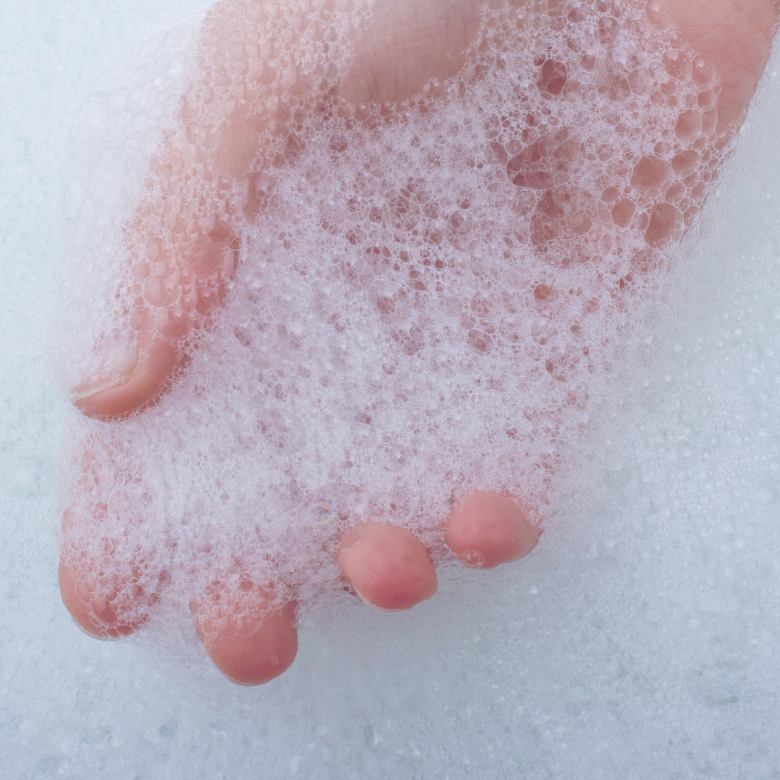
Foam is particularly desirable in personal care products. Shampoos, shower gels and facial cleansers rely heavily on the foaming action provided by surfactants. The foam produced aids in the effective distribution of the product, improves user comfort and helps remove dirt from the skin and hair.
Foaming is equally beneficial in the food industry. Foaming agents, including surfactants, are used in the production of whipped cream, mousses and other foams. These foams influence the texture and taste of various food products. Food-grade surfactants, such as lecithin, are commonly used in these applications.
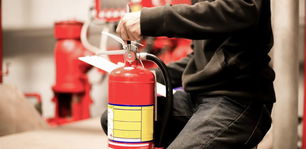
Foam is also a key component of fire-fighting foams, used to extinguish or prevent fires. These foams create a barrier between the fuel and oxygen, thereby smothering the fire. Surfactants used in these foams must generate a stable, durable foam that can cover large areas.
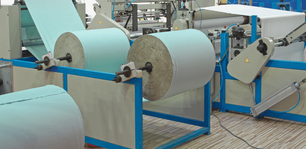
Conversely, high foaming is an undesirable phenomenon in the pulp and paper industry. Air bubbles trapped in the paper pulp cause ‘pinholes’ and holes in the finished sheet of paper, which drastically reduces its strength and print quality.
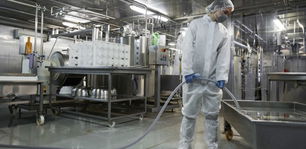
Foam is also undesirable in certain sectors of machine cleaning, particularly in the case of equipment cleaned in closed-loop systems. Foam is compressible, so if it enters, for example, pumps, it causes so-called ‘air entrapment’ (cavitation) and a drop in cleaning pressure, which can lead to the failure of individual components