












































































































It is one of the oldest building materials, which - despite the passage of thousands of years - continues to shape our environment. What does this term actually mean? How is it produced and what makes ceramic bricks, tiles and slabs so durable? Let's find out.
Types, definition, purpose and much more. Learn about the ceramic raw material that is an essential component of durable building materials.
What is building ceramics?
This type of ceramics is actually a group of products intended for use in construction. Due to their specific purpose, they must have certain technical properties (including weather resistance, mechanical strength, durability, as well as thermal and acoustic parameters).
Importantly, it should be remembered that it is not the same as other types of ceramics (sanitary or artistic). Unlike them, as a building material, it must meet much stricter requirements.
Types of ceramics used in construction – overview
Essentially, it can be divided into four main types (wall, roofing, finishing and specialised). Below, we will briefly describe each of them. Wall ceramics mainly include:
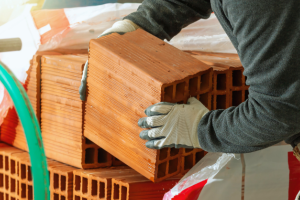
- Solid bricks (without holes). They have high density, are durable and have moderate water absorption. Therefore, they are mainly used in traditional construction.
- Perforated bricks (with holes accounting for up to 10% of their volume). They are lighter and durable.
- Ceramic hollow bricks (differ from perforated bricks in that they have a larger volume of holes.
- Clinker bricks – offer high density, low water absorption and specific aesthetics.
- Facing bricks are chosen mainly for their aesthetic qualities and are available in various surface finishes and colours.
Ceramic roofing materials are known as roof tiles. They can be classified according to their shape and the way they are laid. These include:
- Carp tiles (laid in a crown or scale pattern).
- Interlocking tiles (with special fastening systems).
They offer high bending strength and, above all, frost resistance, tightness and durability.
Finishing ceramics include:
- Wall and floor tiles are classified according to production technology, degree of water absorption and surface finish.
- Clinker tiles – mainly intended for outdoor use. However, there is no reason why they cannot also be used to enhance the interior of buildings.
Dedicated elements and fittings are also used for all types of finishes, including: skirting boards, plinths, steps and corners.
The group of specialised ceramics includes:
- Refractory ceramics – used especially in the construction of fireplaces, stoves and barbecues.
- Road ceramics – all kinds of paving fittings, kerbs, paving slabs, etc.
- Ceramic installation elements – including pipes, sewer fittings and drainage elements.
What raw materials are used in the production of building ceramics?
Although the word ‘ceramics’ is a very broad concept, ultimately the properties and final purpose of this type of product are largely determined by the composition of the raw materials used and the method of production. Ceramic raw materials are divided into two main groups – clay and non-plastic.
Clays (which are plastic) are the basis of ceramic mass. They are fine-grained minerals, the composition of which includes kaolinite, montmorillonite and illite. Each of them offers different properties, including parameters, colours, appearance, etc.
Non-plastic raw materials are the backbone of all building ceramics. They include: quartz (reduces shrinkage during drying and firing), silicon, clay, alkalis, calcium, magnesite, dolomite, talc, etc.
Each of these components is an important element that determines the final properties of ceramics. While some are responsible for better mechanical properties, others lower the melting point, and still others increase fire resistance and even improve mechanical properties.
Need more information about ceramics?
Would you like to learn more about raw materials and ceramic technologies? We recommend that you visit our company blog. If you are looking for proven solutions for building ceramics or would like to learn about the rest of the PCC range (including additives for ceramics), you will find all the necessary information directly from us.
- Ceramika Paradyż. (b.d.). Płytki klinkierowe – zastosowanie i zalety. Pozyskano 20 października 2025 z https://www.paradyz.com
- Dolata, A. (2017). Ceramika budowlana i drogowa. W: Materiały budowlane: właściwości, technologia, zastosowanie (s. 89–112). Warszawa: Wydawnictwo Naukowe PWN.
- Górski, J. (2012). Surowce ceramiczne i technologia ceramiki budowlanej. Kraków: Wydawnictwo Politechniki Krakowskiej.
- Izolacje.com. (2022). Właściwości techniczne ceramiki budowlanej – nasiąkliwość, mrozoodporność i inne kluczowe parametry. Pozyskano 20 października 2025 z https://www.izolacje.com.pl
- Krajowa Izba Gospodarcza Ceramiki Budowlanej. (b.d.). Ceramika – tradycyjny materiał we współczesnym budownictwie. Pozyskano 21 października 2025 z https://www.kigcb.pl
- PN-EN 771-1:2011. Wymagania dotyczące elementów murowych – Część 1: Elementy ceramiczne. Warszawa: Polski Komitet Normalizacyjny.
- Rashid, M. A., & Ahmad, N. (2021). Mechanical properties and microstructure of fired clay bricks: A review. Construction and Building Materials, 269, 121299. https://doi.org/10.1016/j.conbuildmat.2020.121299
- Reed, J. S. (1995). Principles of Ceramics Processing (2nd ed.). New York: Wiley-Interscience.