












































































































Micelles are microscopic clusters of molecules characterised by a spherical structure. They are a commonly used and very effective group of surface-active compounds, i.e. surfactants. Thanks to their unique properties, they play a very important role in many industries, including cosmetology.
Due to their structure, micelles practically absorb all kinds of impurities from the surface to which they are applied. Micelles are most often mentioned in the context of facial cleansing cosmetics, but they are also ingredients in products such as laundry detergents and dishwashing liquids. Micellar solutions are characterised by their ability to dissolve poorly soluble compounds, which is the definition of the solubilisation process.
Structure and properties of micelles
The structure of micelles determines their unique physicochemical properties. In this section, we will look at how micelles are formed, what they are composed of, and what processes determine their behaviour in solutions.
Through the eyes of a chemist
Micelles are nothing more than associative colloids formed as a result of the micellisation process. This process refers to the transformation of amphiphilic molecules or ions, which, as a result of dissolution, undergo self-association into larger clusters.
Micelles are therefore not a specific group of chemical compounds, but rather a specific form of organisation of their molecules. This spontaneous transformation resulting in the formation of micelles is characteristic of various organic substances whose molecules are composed of two parts with significantly different polarities.
When the content of surfactants in a solution increases, at a certain concentration of associates, these characteristic structures begin to form. The starting point for such transformations is called the CMC concentration.
What does CMC stand for?
CMC, or critical micellisation concentration, is the concentration at which micelles begin to form as a result of the self- e of accumulated monomers into larger aggregates. This formation of clusters of molecules is also accompanied by a change in their physical properties.
Above the CMC, such a group of molecules remains in equilibrium with individual molecules, thus becoming a thermodynamically stable form. This equilibrium is a key point of transition, as it can proceed continuously in both directions. For example, during dilution, the micelles break down again. Below the CNC concentration, the surfactant molecules move freely in the solution without any organised structure.
Physical properties of micelles
As the concentration of surfactant in the solution increases, the following changes occur:
- Surface tension,
- Electrical conductivity,
- Light scattering intensity,
- Viscosity.
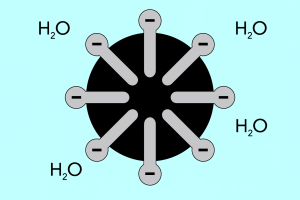
Head and tail – structure of micelles
The structure of micelles can be divided into two main parts, which differ significantly in polarity and are called:
- Hydrophilic head, which has a high affinity for water. It is the part of the micelle that is responsible for the tendency of particles to combine with water, but also to repel fats.
- The hydrophobic tail, also known as the lipophilic tail, which has the opposite effect – it attracts molecules to fats and repels water.
The hydrophobic area is most often hydrocarbon chains, radicals:
- alkyl,
- alkylaryl,
- fluorinated hydrocarbon radicals.
The hydrophilic area consists of groups that interact strongly enough with water, such as ionogenic groups. Non-ionic groups, such as ether groups, can also form part of the hydrophilic area of micelles, but this usually requires the presence of a larger number of polar groups in the molecule.
The micellisation process
Due to the fact that the non-polar part of the substance, for example the alkyl chain of a single dispersed surfactant molecule, has a large surface area in contact with water, and the interaction between several water molecules is much stronger than their interaction with the –CH2 groups present in the chain, the entropy of the system decreases and the water molecules begin to organise themselves at the site of the alkyl chain.
This causes a kind of displacement of hydrocarbon chains from the interior of the aqueous phase. As the concentration of the surfactant increases, so does the number of collisions between them. This also increases the likelihood of aggregation and thickening of the molecules.
The condensation of molecules is accompanied by a decrease in free enthalpy. This is also the result of the combination of non-polar residues with a non-polar core in a liquid state, which is separated from the aqueous phase by polar groups.
Once the aforementioned CMC concentration, i.e. the critical micelle concentration, is reached, spherical clusters accumulate, in which the polar groups of individual particles are directed towards the aqueous phase, while the non-polar hydrocarbon chains form the interior. The micelles formed in this way are called normal micelles.
In organic solvents, reverse micelles may occur, in which the hydrophobic part is located on the outside.

Types and examples of surfactants
The type of surfactants used to form micelles has a huge impact on their structure and functionality. Below you will find the most common types and examples of surfactants that form micelles
Examples of surface-active ions
Negatively charged ions, cations:
- carboxylate,
- sulphate,
- sulphonate,
- phosphate.
Positively charged ions, cations:
- ammonium,
- phosphonium.
Types of surfactants
- Ionic surfactants
- Anionic, for example SDS, or Sodium dodecylsulfate,
- Cationic, for example CTAB, or cetyl trimethyl ammonium bromide,
- Amphions, i.e. ions called amphiphilic or bipolar, which have both a positively charged cationic group and a negatively charged anionic group, e.g. Lecithin, i.e. Phosphatidyloline.
- Non-ionic surfactants, for example Polyoxyethylenes.
Surface activity of surfactants and micelle structure
This parameter, characteristic of surface-active compounds, increases with the number of methylene groups present in the hydrocarbon chain.
Due to the structure of the chain, micelles can be divided into:
- Single-chain
- Anionic, e.g. SDS,
- Cationic, e.g. CTAB.
- Double-chain
- Anionic, e.g. AOT, i.e. sodium bis(2-ethylhexyl) succinatesulphonate,
- Cationic, e.g. dihexadecyldimethylammonium bromide.
- Molecular, e.g. MGDG, i.e. monogalactosyl diglyceride.
Application of micelles
Micelles have a wide range of applications, from cosmetology to pharmaceuticals and the chemical industry. Learn about the most important areas where their properties are used in practice.
Effective skin cleansing
This is possible thanks to the presence of both lipophilic and hydrophilic particles. For example, in make-up removers containing micellar water, hydrophobic particles bind to sebum and make-up residues on the skin, while hydrophilic particles attract dust and dirt. This results in a dual cleansing effect, enabling effective and thorough cleansing without unnecessary drying or irritation.
Micellar products are even recommended for sensitive skin types due to their gentle action. There is no need to scrub or press hard with cotton pads, and the action of these colloids is compared to that of a magnet on dirt. Aqueous solutions with micelles do not disturb the hydrolipid layer of the epidermis.
Formulation of micellar cosmetics
Another advantage of micelles, which are very small particles, is that there are no restrictions on the formulations in which they can be used. They can be used in their most popular form – micellar water – but also in creams and lotions.
Highly concentrated gel formulas are also available, which do not require the use of towels or cotton pads, but only need to be massaged into the skin and rinsed off with water.
Three-stage action of micelles
- Attracting impurities thanks to hydrophobic tails,
- Encapsulation, which traps fat and dirt molecules inside the micelles,
- Removal of impurities trapped in micelles through hydrophilic heads remaining in contact with the aqueous phase.
Other industrial applications of micelles
- Cosmetology, mainly micellar liquids and make-up remover lotions, but also micellar shampoos for deep cleansing of the scalp and shower gels.
- Pharmacy, for example to increase the bioavailability of active substances by introducing drugs with limited solubility into the body in the form of non-ionic micellar solutions.
- Cleaning products – the aforementioned solubilisation process explains the physicochemistry of washing. Micellar colloids in the form of solutions surround fat, separate dirt and remove it from the fabric. When ionic surfactants are used, the dirt particles and the surface to which they adhere acquire the same charge, making them easy to separate from each other.
- Physical and chemical processes: micellar catalysis, inhibition of chemical reactions, flotation and oil recovery processes.
- Witek K. Synteza, właściwości powierzchniowe i zastosowanie surfaktantów amfoterycznych, zawierających ugrupowania labilne, Politechnika Wrocławska 2022
- K.Michocka Otrzymywanie i właściwości użytkowe nowych surfaktantów z ugrupowaniem cukrowym, Uniwersytet Ekonomiczny w Poznaniu 2012
- A.Piotrowska-Kirschling, J.Drzeżdżon, L.Chmurzyński, D.Jacewicz Krytyczne stężenie micelarne i metody jego wyznaczania, Wiadomości chemiczne 2018
- https://wydawnictwo.ue.poznan.pl/books/978-83-8211-090-6/sample.pdf
- https://home.agh.edu.pl/~nmos1/FUK/fizykochemia_powierzchni_skany/15/dutkiewicz_15.pdf
- https://phavi.umcs.pl/at/attachments/2018/0608/143246-chemia-koloidow-cwiczenie-1.pdf