






























































































































Choosing the right base oil is one of the most important decisions in the lubricant formulation process. Although traditional mineral oils still dominate in many standard applications, the industry is increasingly turning to synthetic bases.
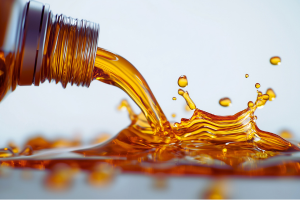
Mineral and synthetic oils – the differences
Mineral oils and synthetic oils are the base components in the production of lubricants. Although both types of base oils perform the same function – forming a film that separates working surfaces – differences in their physicochemical properties affect the characteristics of the finished formulations.
The most important characteristics of mineral and synthetic oils are:
Viscosity index
The viscosity index indicates how viscosity changes with temperature. The lower the index, the greater the change in viscosity with temperature. It is determined in accordance with ASTM D2270, based on kinematic viscosity at 40 °C and 100 °C.
When analysing different oil bases, it can be seen that, in the case of mineral oils, the increase in viscosity as the temperature drops is much more rapid than in synthetic products. Whilst mineral oils have an index of 94–97, for synthetic bases this value exceeds 110. It follows that synthetic oils exhibit significantly greater stability of parameters across a wide temperature range than their mineral counterparts.
| Feature | Mineral | Synthetic |
| Viscosity | less stable | more stable |
| Pour point | higher | lower |
| Service life | shorter | longer |
Homogeneity
The homogeneity of base oils determines how consistent their physicochemical structure is. It is determined using advanced physicochemical and instrumental techniques. Among the analytical methods used, gel permeation chromatography (GPC) is worth mentioning.
As petroleum derivatives, mineral oils naturally exhibit lower compositional homogeneity. They consist of a mixture of many chemical compounds with varying structures, including differences in carbon chain length and the substituents present.
Synthetic oils, being the product of chemical synthesis, are characterised by a high degree of structural homogeneity. This is a key factor determining their high viscosity stability over a wide temperature range.
Pour point
At a specific (very low) temperature, a lubricant may solidify and cease to flow, thereby ceasing to act as a lubricant. The pour point is therefore the lowest temperature at which the oil is on the verge of losing its fluidity, whilst still remaining a liquid.
Typically, the pour points of mineral-based lubricants are below zero degrees Celsius (for example, -10°C). Synthetic lubricants, on the other hand, can have pour points ranging from -30°C to -40°C.
Biodegradability
With growing environmental awareness, increasing attention is being paid to the search for environmentally friendly solutions – including in the field of lubricants.
From an environmental perspective, synthetic oils often have a slight advantage over mineral oils. Synthetic oils can be produced in such a way as to be more biodegradable and environmentally friendly, reducing their ecological footprint compared to conventional mineral oils. Furthermore, their longer service life means they need to be disposed of less frequently, which further minimises their environmental impact. Among biodegradable synthetic oils, polyalkylene glycols (PAGs) are particularly noteworthy.
The biodegradability of oils and greases is assessed using the test in accordance with OECD 301F.
Hydrolytic stability
The hydrolytic stability of a lubricant determines the ability of its components to remain stable in the presence of water. High hydrolytic stability indicates that the lubricant does not undergo hydrolysis or decomposition under the influence of moisture. It is determined in accordance with the guidelines of ASTM D2619.
In the case of mineral oils, it is mainly contaminants and incorrectly selected additives that are prone to changes when in contact with water. This susceptibility is explained by the presence of by-products from the crude oil refining process.
In contrast, synthetic bases, such as PAO, are characterised by exceptionally high hydrolytic stability. PAG oils exhibit stability similar to that of hydrocarbon bases, which classifies them as products with good resistance. Synthetic esters and vegetable oils behave in the opposite manner; due to their chemical structure, they exhibit significantly lower stability and are more susceptible to degradation in a humid environment.
Service life
One of the key advantages of synthetic oil is its greater durability and service life compared to mineral oil. Synthetic oils typically have a longer service life and can withstand longer intervals between oil changes. This not only reduces the frequency of maintenance but also contributes to overall savings in the long term.
Application potential of PAG base oils
Polyalkylene glycol (PAG)-based base oils, thanks to their unique chemical structure, are indispensable in many key industries. They are designed to operate under extreme operating conditions, offering a range of technological advantages over traditional mineral oils.
Their strong market position is determined by properties including, amongst others:
- High viscosity index – exceeding 180. This is the highest compared to mineral oils or other synthetic base oils,
- Structural uniformity – polyalkylene glycols are produced through chemical synthesis. This means that individual PAG molecules are of similar size. As a result, finished products exhibit lower internal fluid friction, enhancing the energy efficiency of machinery,
- High chemical stability – PAG oils have a low level of unsaturation. This ensures good resistance to oxidation and chemical degradation,
- Hydrolytic stability – they exhibit very good stability when in contact with water. When the lubricant comes into contact with water, it retains its protective properties,
- Good biodegradability – PAG oils break down in the natural environment. In this respect, they are far superior to mineral bases.
PAG base oils in the PCC Group’s range
The PCC Group is a leading manufacturer of polyalkylene glycols (PAG) designed for a wide range of applications. PAG base oils are marketed under the Rokolub brand. The range includes water-soluble Rokolub products (50-B series, 60-D, e.g. Rokolub 50-B-46), water-insoluble (P-B and PO-D series, e.g. Rokolub P-B-46) and those miscible with mineral oils (MOS series, e.g. Rokolub MOS 32).