




























































































































Every drop of spray solution that fails to reach the plant surface means reduced treatment efficacy, unnecessary wastage of the product and a greater risk of environmental impact. That is why minimising spray drift has become one of the most important challenges facing modern spraying technology.

Spray drift – the movement of droplets beyond the treatment area – reduces the effectiveness of plant protection and increases the risk of contamination of areas adjacent to the application site. Growing demands regarding the effectiveness of treatments, the efficient use of plant protection products and environmental protection mean that minimising drift is now one of the key elements of modern spraying technology. This is also of particular importance in the case of spraying carried out using drones, where small volumes of spray mixture require a very high degree of application precision.
The answer to these challenges lies in anti-drift adjuvants – additives to the spray mixture designed to minimise the formation of droplets most prone to drift and to improve the quality of the entire spraying process. However, modern solutions increasingly fulfil multiple functions simultaneously. In addition to reducing drift, they improve the wetting of plant surfaces, increase the retention of the spray mixture and stabilise tank mixtures, thereby enhancing the effectiveness and safety of the treatments carried out.
Modern anti-drift agents comprise various groups of chemical compounds that affect the properties of the spray mixture in different ways. Alongside products based on oils, silicones or polymers, block copolymers of ethylene oxide (EO) and propylene oxide (PO) are playing an increasingly important role. Their properties mean they are used in modern adjuvants designed to reduce droplet drift, intended for demanding spraying techniques.
Why does spray drift occur?
The most important factor influencing the susceptibility of the spray mixture to drift is the size of the droplets formed during atomisation. Droplets with a diameter of less than 100–150 µm are particularly susceptible to being carried away by wind and turbulence, and they also evaporate more quickly before reaching the plant surface.
However, this does not mean that producing only large droplets is the solution. Whilst they are less prone to drift, they can compromise the uniformity of plant coverage. Effective spraying therefore requires striking the right balance between minimising drift and ensuring good coverage of the treated area.
Many factors influence the size of the droplets produced, such as the type of nozzle, operating pressure, weather conditions and the properties of the spray liquid itself. It is precisely this last factor that means that appropriately selected adjuvants can effectively help to reduce drift, complementing a correctly chosen application technique.
How do anti-drift adjuvants work?
These adjuvants modify the physical properties of the spray liquid, influencing the spraying process and the size distribution of the resulting droplets. The result is a reduction in the proportion of fine droplets – which are most susceptible to drift – whilst maintaining the conditions necessary for effective coverage of the sprayed plant surface.
Consequently, a greater volume of spray mixture reaches the application site, which translates into more effective agrochemical treatments. At the same time, the risk of the product being unintentionally deposited on neighbouring crops or areas not covered by the treatment is reduced, as is the risk of active substances entering watercourses and water bodies. Reducing drift therefore not only increases the effectiveness of the treatment but also its safety for the environment.
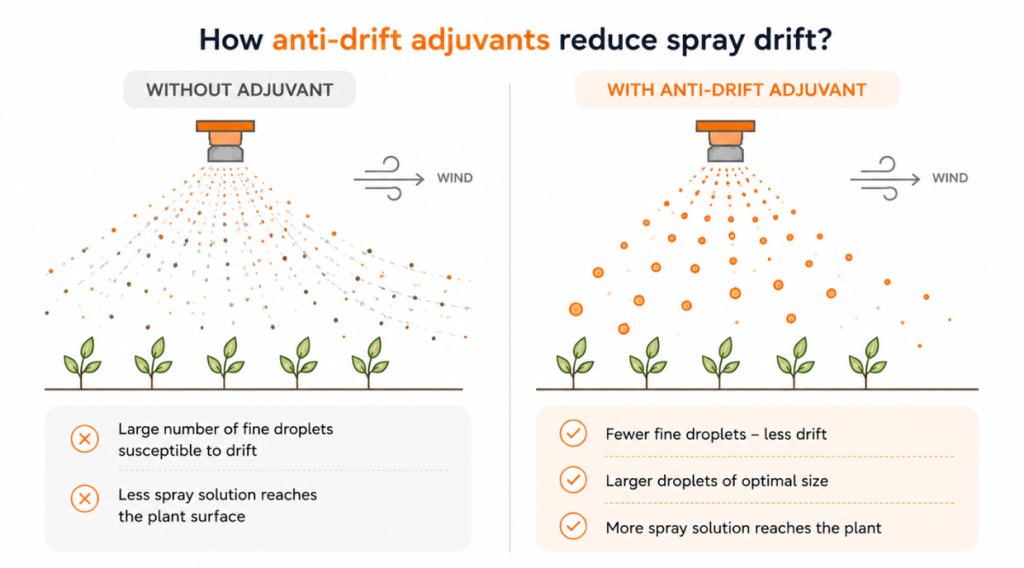
Figure 1. A schematic representation of the effect of an anti-drift agent on droplet size distribution and the reduction of spray drift.
Why do not all adjuvants work in the same way?
Although all anti-drift agents share the same objective, they do not achieve it in the same way. Their properties are determined primarily by their chemical structure, which influences the behaviour of the spray mixture during application. As a result, different groups of compounds differ not only in their effectiveness at reducing drift, but also in their impact on the wetting of plant surfaces, the retention of the spray mixture, and their compatibility with plant protection product formulations.
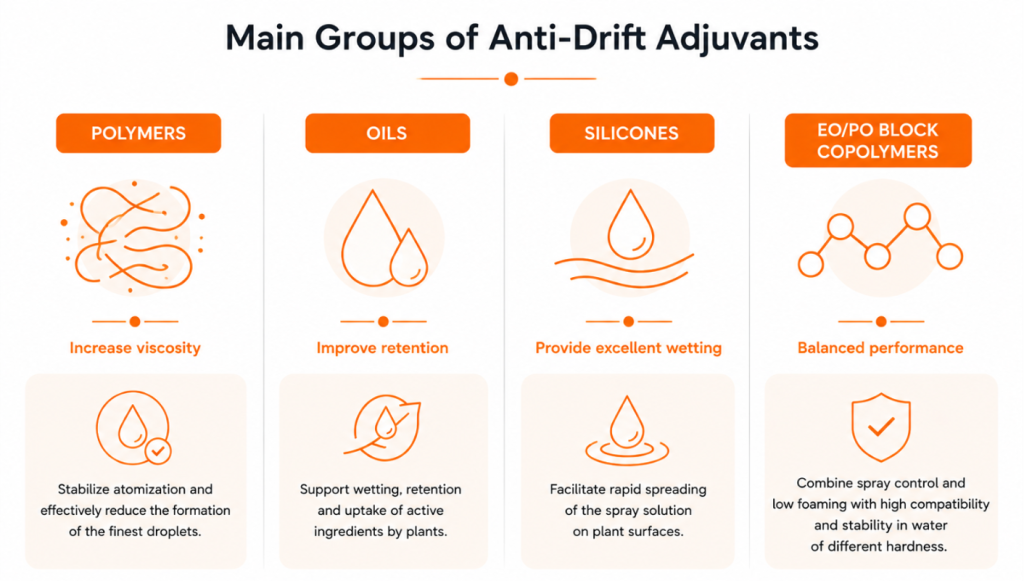
Figure 2. Main groups of compounds used in formulations to reduce spray drift and the predominant mechanisms of their action.
Polymeric adjuvants, most commonly based on polyacrylamides and acrylic copolymers, are among the most widely used solutions for reducing spray drift. They work by increasing the viscosity of the spray mixture, which stabilises the spraying process and effectively limits the formation of the finest droplets. Consequently, they are among the most effective solutions for reducing drift. However, the high molecular weight of the polymers can make it difficult to prepare the spray mixture and, in some formulations, increase the risk of excessive viscosity.
Oil-based adjuvants, such as methylated oils (MSO) and paraffin oils, utilise a different mechanism. As well as reducing drift, they improve wetting and retention of the spray mixture on plant surfaces and may aid the uptake of active ingredients. Their anti-drift effect is, however, generally weaker than that of polymeric adjuvants, and in some applications the possibility of phytotoxicity must be taken into account.
Modified silicones constitute a separate group, characterised by very good wetting properties and the ability to rapidly distribute the liquid across the plant surface. For this reason, they are particularly valued where maximising coverage of the sprayed surface is of key importance. However, their effect on reducing drift is generally less pronounced than that of adjuvants specifically designed for this purpose.
Block copolymers of ethylene oxide and propylene oxide (EO/PO) are attracting increasing interest. They combine the properties of surfactants with the ability to control the spraying process, whilst ensuring low foaming, high compatibility with plant protection product formulations and good stability in water of varying hardness. Unlike conventional polymers, they do not cause an excessive increase in viscosity or pose a risk of the mixture gelling, thereby ensuring more predictable behaviour of the spray mixture under varying application conditions . It is precisely these EO/PO copolymers that currently represent one of the most important areas of development for modern formulations designed to reduce spray drift.
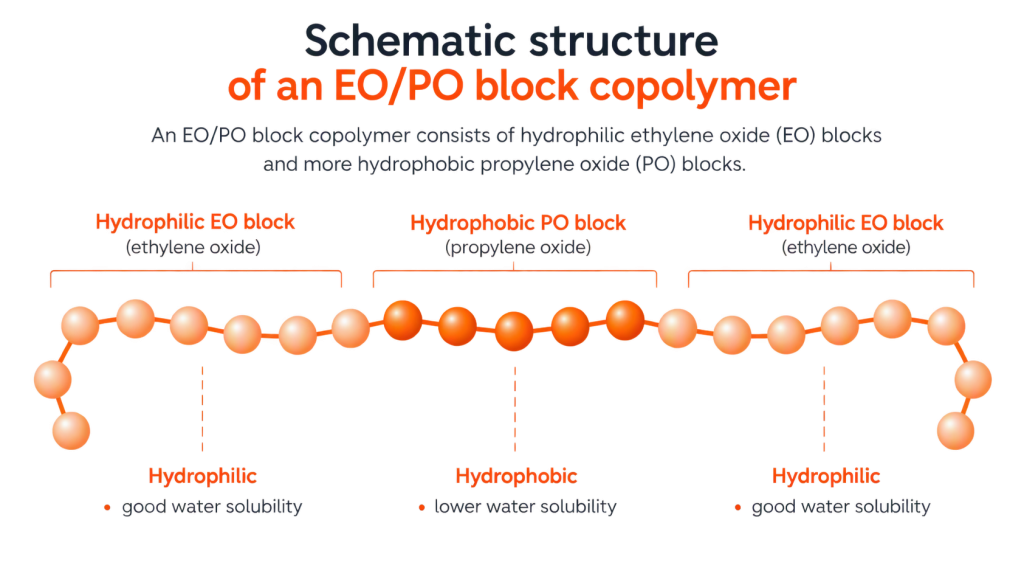
Figure 3. The diagram illustrates the structure of an EO-PO-EO block copolymer
ROKAmer 6500 surfactant range
PCC Exol’s response to the growing interest in solutions that reduce spray drift is the ROKAmer® product range, designed primarily for use in formulations. These products can be used as ingredients in formulations for plant protection products, foliar fertilisers and adjuvants, helping to achieve the desired application properties whilst maintaining high stability and compatibility of the mixture.
The ROKAmer 6500 series is based on EO/PO block copolymers with an average molecular weight of approximately 6500 Da, which is a characteristic feature of this group of surfactants.
This group comprises three variants tailored to different user requirements:
- ROKAmer 6500 – an anhydrous product,
- ROKAmer 6500W – an aqueous concentrate protected by an MIT/CIT preservative system,
- ROKAmer 6500BW – an aqueous concentrate protected by a BIT preservative.
The individual variants retain the same performance characteristics, differing primarily in their commercial form and the preservative system used. This allows the user to select the product that best suits the requirements of the technological process and their preferred method of application.
Summary
Effectively minimising spray drift requires a comprehensive approach, encompassing the correct selection of sprayers and spray parameters, taking weather conditions into account, and the appropriate design of the formulation. Only by combining these elements can the full potential of the treatment be realised.
Growing demands regarding treatment efficacy, environmental safety and formulation quality mean that components supporting the control of spray drift are becoming increasingly important. An example of such a solution is the ROKAmer® group of surfactants, comprising ROKAmer 6500, ROKAmer 6500W and ROKAmer 6500BW. With both an anhydrous product and aqueous concentrates available, users can select the variant that best meets the requirements of the production process and the target formulation.
Modern anti-drift solutions are increasingly becoming an integral part of agrochemical formulations. Appropriately selected surfactants can enhance the effectiveness of treatments, as well as their safety for the user and the environment.
- Hewitt, A.J. (2024). Adjuvant Use for the Management of Pesticide Drift, Leaching and Runoff. Pest Management Science, 80(10), 4819–4827.
- Nuyttens, D., De Schampheleire, M., Baetens, K., Sonck, B. (2007). The Influence of Operator-Controlled Variables on Spray Drift from Field Crop Sprayers. Transactions of the ASABE, 50(4), 1129–1140.
- Matthews, G.A., Bateman, R., Miller, P. (2014). Pesticide Application Methods. 4th ed. Wiley-Blackwell.
- Green, J.M., Beestman, G.B. (2007). Recently Patented and Commercialized Formulation and Adjuvant Technology. Crop Protection, 26(3), 320–327.
- Chen, P., Douzals, J.P., Lan, Y., et al. (2022). Characteristics of Unmanned Aerial Spraying Systems and Related Spray Drift: A Review. Frontiers in Plant Science, 13, 870956.
- Li, S., Zhang, H., Wang, Z., et al. (2023). Anti-Drift Technology Progress of Plant Protection Applied to Orchards: A Review. Agronomy, 13(11), 2679.
- Jomantas, T., Lekavičienė, K., Steponavičius, D., Andriušis, A., Zaleckas, E., Zinkevičius, R., Popescu, C.V., Salceanu, C., Ignatavičius, J., Kemzūraitė, A. (2023). The Influence of Newly Developed Spray Drift Reduction Agents on Drift Mitigation by Means of Wind Tunnel and Field Evaluation Methods. Agriculture, 13(2), 34