





























































































































Understanding the complex interactions occurring at the interface of moving surfaces is the fundamental task of tribology. This knowledge enables the effective use of lubricants, which is crucial for extending the service life of machinery and optimising production processes.

What is tribology?
Tribology is defined as the science and technology concerning surfaces in relative motion and mutual interaction. It encompasses the study of friction, wear and lubrication, as well as the interactions occurring at the interface between contacting bodies. These processes include, amongst others, the transfer of forces, the conversion of mechanical energy, physicochemical transformations, and mechanical interlocking phenomena resulting from surface morphology and topography.
The key objective of tribology is to understand surface interactions, thereby enabling problem-solving and the identification of appropriate solutions. This field is interdisciplinary in nature – it draws on expertise from mechanical engineering, materials science, chemical engineering and many other disciplines. Such a broad approach is essential to fully explain the complex physical phenomena occurring in the friction zone.
The mechanism of friction
Friction is, by definition, the tangential resistance to motion between two solid bodies in contact. The magnitude of this resistance is a function of the materials, geometry and surface properties of the contacting bodies, as well as the operating conditions and environment. This mechanism results from physical interactions occurring primarily on a microscopic scale.
The following types are distinguished:
- Kinetic (motion) friction – resistance between two surfaces in contact and moving relative to one another,
- Static friction – present during the transition from rest to motion, as well as when motion ceases. Generally greater than kinetic friction.
The surfaces of bodies, even those that appear perfectly smooth, are full of depressions and irregularities at the molecular level. During motion, these become interlocked and intermeshed, and overcoming these barriers requires the supply of external energy.
Adhesion is also a key phenomenon in the context of friction. At the points of actual contact between bodies, intermolecular bonds form, including van der Waals forces and capillary forces. Additionally, during the friction process, electrical charges are generated on the surfaces (the triboelectric effect). These charges increase the surface ionic forces, which promotes the formation of adhesive contact forces.
View our selection of anti-adhesive agents.
It is worth noting that friction occurs not only at the interface between two different objects, but also within a single body, when its layers or particles move relative to one another. This phenomenon is known as internal friction. Its nature depends on the state of matter – in gases and liquids it manifests as viscosity (relatively small forces), whereas in solids it is much stronger, due to the ordered arrangement of structural elements.
Lubricants as friction-reducing substances
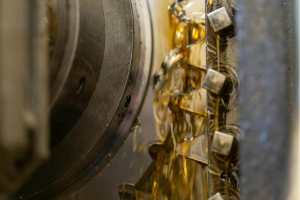
Lubrication is the fundamental method used in the maintenance of machinery for manufacturing products. In the case of sliding components, such as piston-cylinder systems, gears and cams, lubrication between two or more components is essential to ensure the smooth operation of the machine.
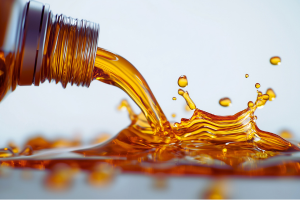
A lubricant is a substance designed to reduce friction between contacting surfaces, which ultimately reduces the heat generated during the movement of these surfaces. The mechanism of action is based on replacing dry friction (between solids) with the internal friction of a low-viscosity fluid or the formation of a stable boundary layer.
In addition to reducing friction, proper lubrication contributes to:
- Heat dissipation,
- Noise reduction,
- Corrosion protection,
- Effective sealing,
- Removing contaminants.

Base oil – the key factor in reducing friction
Base oils are the raw materials used in the production of lubricants, and their properties have a significant impact on the performance and characteristics of the finished product, including viscosity, stability/durability and load-bearing capacity.
There are five main groups of base oils:
Groups I, II, III – petroleum-derived oils
Group I comprises the cheapest oils obtained through simple solvent refining. They are characterised by a hydrocarbon saturation of < 90% and a viscosity index of 80–120. Base oils in the second group are produced using a hydrocracking process. They exhibit better properties than Group I oils. They contain fewer impurities and have a higher viscosity index. Group III oils are products of the highest purity, subjected to deep hydrocracking. Their properties are similar to those of synthetic oils.
Group IV – synthetic oils
They are characterised by high thermal and oxidative stability. Furthermore, they exhibit low viscosity variation over a wide temperature range.
This group of compounds includes polyalphaolefins (PAO), which are popular synthetic hydrocarbons. These are products of the polymerisation of ethylene obtained from crude oil through the cracking of naphtha. Due to their complete saturation (no double bonds), these oils are resistant to oxidation and degradation at high temperatures.
Group V – other base oils
This group includes all other bases, including esters, polyalkylene glycols (PAG) and silicones. Plant-based alternatives to mineral and synthetic oils are also becoming increasingly common. These are mainly natural triglycerides, such as rapeseed or sunflower oil.
Base oils – the PCC Group’s range
The PCC Group offers a full range of specialist base oils used in synthetic lubricants. These products are used in hydraulic fluids, machining fluids, compressors, industrial gearboxes and in the textile industry.
A wide range of products is available within the Rokolub series. These are primarily:
- Water-soluble polyalkylene glycols (PAG) (Rokolub 50-B series and Rokolub 60-D series),
- Water-insoluble polyalkylene glycols (PAG) (Rokolub P-B series and Rokolub PO-D series),
- Phosphate esters (Rokolub FR I series and Rokolub FR T series).
AW and EP additives, and tribological friction characteristics
In oils and greases used in industry, base oils are the main component. Performance-enhancing additives play a significant role, improving the natural properties of base oils.
Additives that improve lubricating properties are chemical compounds that participate in tribochemical reactions. The most commonly used are additives that control wear and friction. They come in the form of anti-wear (AW) additives or extreme pressure (EP) additives.
View our selection of anti-wear additives.
Anti-wear additives (AW)
AW additives are lubricant components that react chemically with the metal surface being protected, forming a protective coating that shields the metal from wear under boundary lubrication conditions. Anti-wear additives create a surface that is less susceptible to damage than the unprotected base metal.
Common types of anti-wear additives include zinc compounds (e.g. zinc dialkyldithiophosphate, ZDDP), molybdenum compounds (e.g. molybdenum dithiocarbamate), and phosphorus- and boron-based additives.
The PCC Group offers AW additives – these are products from the Rokolub AD series (e.g. Rokolub AD 246 ultra).
Extreme-pressure (EP) additives
Their main function is to prevent surface contact under extremely high loads. They react chemically with metal surfaces, forming a protective layer that shields them from seizure and wear. EP additives allow the grease to withstand short-term pressures exceeding its normal load-bearing capacity without damage. They usually act more strongly and more aggressively than anti-wear additives.
Typical examples of EP additives include sulphur-based compounds (e.g. sulphurised greases and oils), phosphorus compounds (e.g. phosphates, thiophosphates) or substances such as graphite and molybdenum sulphides.
In the PCC Group’s portfolio, EP additives are primarily products from the EXOfos series (e.g. EXOfos PA-080S, EXOfos PB-184).
Explore the full range of extreme pressure additives.