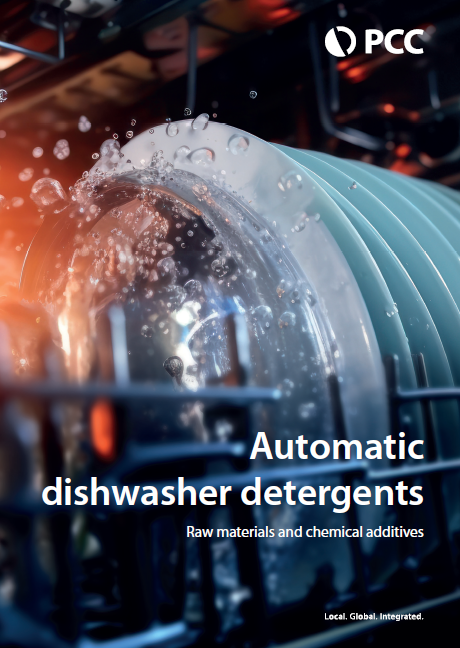
Dishwashers are invaluable appliances in modern kitchens. They offer a number of hygienic benefits and help save a lot of time and energy. Nowadays, it is difficult to imagine effective functioning without these appliances.
However, even the most efficient dishwasher will not guarantee the desired results without a good quality detergent.
Currently, there are three main groups of dishwasher detergents:
An effective dishwashing detergent for dishwashers has several key features that result from a properly composed chemical formulation. The most important functions it should perform are cleaning, degreasing and polishing. Surfactants play an important role in these processes.
Thanks to their amphiphilic structure, surfactants effectively reduce surface tension and increase the wettability of detergents, which directly determines their high cleaning properties. They also have an emulsifying effect on grease – they surround dirt particles and separate them from the surface of the dish. In addition, surfactants are important raw materials not only in the production of cleaning agents, but also in rinse aids, which are used on their own or are often found in dishwasher capsules.
The PCC Group has a wide range of chemical raw materials for the production of dishwasher detergents in its portfolio. The POLIkol series (e.g. POLIkol 1500, POLIkol 6000, POLIkol 4500) is a group of additives used as dispersants, emulsifiers and wetting agents. In the production of dishwasher detergents, they are used as carriers of active substances and binding materials in dishwasher tablets. In addition, they improve the rheological properties of finished formulations. The advantage of products in this series is the availability of the raw material in the form of flakes or pellets, which is very convenient for formulators due to the ease of dosing and storage of the product.
Another category of additives is ROKAnols (e.g. ROKAnol LP1012, ROKAnol GA3, ROKAnol GA7LAW). They are classified as non-ionic surfactants from the group of alkoxylated fatty alcohols. Their pronounced surface activity allows them to be used in detergents and cleaning agents for dishwashers, where reduced foaming is required. Due to their unique chemical structure, they exhibit very good wetting properties, combined with low foaming properties. Some ROKAnols are used as co-surfactants in all types of cleaning formulations, especially in products intended for industrial and institutional applications.
EXOalc 1618 is also an important raw material in the production of dishwasher detergents. It acts as a rheological modifier. At the same time, the product affects the application properties of the preparation – it improves spreadability, provides slip and can promote foaming. It has very good cleaning properties and creates effective foam. It can be used as an emulsion stabiliser.
The PCC Group places great emphasis on the quality of the raw materials it supplies, offering products of high purity and effectiveness. Many of them have international quality certificates.
The portfolio also offers a wide range of environmentally friendly products. Most of the surfactants offered are biodegradable in accordance with the biodegradability criteria set out in Regulation (EC) No 648/2004 on detergents.
In addition, products such as ROKAnol T20 MB belong to the group of raw materials covered by the RSPO certificate in the Mass Balance model. This means that the palm oil used to produce the basic raw material in ROKAnol T20 MB comes from crops that do not contribute to the depletion of natural resources. At the same time, its production respects the rights of people living in oil palm cultivation areas.