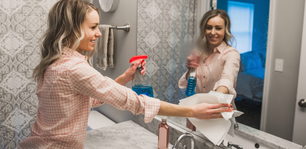
Professional detergents for cleaning hard surfaces are advanced formulas that require careful selection of raw materials. Surfactants play a key role in ensuring effective dirt removal, as do auxiliary substances that affect the stability and application properties of the finished formulations.
Specialised chemical preparations dedicated to hard surfaces are designed to effectively remove dirt while protecting the cleaned surfaces.
Maintaining cleanliness requires precisely selected detergent formulations that will work well in a variety of applications:
The effectiveness, safety and efficiency of every detergent for cleaning hard surfaces depends on the raw materials used in its production.
The production of detergents dedicated to cleaning hard surfaces requires careful selection of raw materials that will effectively remove dirt without damaging the substrate.
Surfactants are the main factor actively involved in the cleaning process. Their molecular structure and surface activity determine the product’s ability to remove contaminants.
The PCC Group’s portfolio includes a wide range of surfactants dedicated to the detergent industry:
These are crucial in degreasing and low-foaming formulations (ideal for machine washing). In this group, ROKAnol® H5, for example, exhibits high surface activity and penetrating ability. Its great advantage is its synergy with other non-ionic, anionic and cationic surfactants. The ROKAnol® LP series also includes a large group of products with high application properties.
Mainly dedicated to manual washing. Among anionic surfactants, ROSULfan L/PH is one of the basic, universal products for washing and cleaning applications. It has limited resistance to hard water, which is why it is often used in combination with SULFOROKAnols. This group includes, for example, SULFOROKAnol L270/1 MB, which has excellent washing properties, increased resistance to hard water, emulsifiability and foaming properties.
They are chosen for their mild action and good disinfecting properties. The PCC Group’s offer includes, among others, ROKAmina K30B MB. It is a high-purity product from the betaine group. In combination with anionic surfactants (SLS, SLES, ABSNa), it exhibits a positive, synergistic increase in foam volume and improves the stability of preparations. An additional advantage is its antistatic effect – betaines reduce static charge.
As a manufacturer of specialised raw materials for the production of detergents for cleaning hard surfaces, the PCC Group offers a wide range of products that serve as auxiliary substances.
These include, for example, dispersants (e.g. ROKAnol® K3, ROKAnol® O10) that help to achieve a homogeneous consistency in the formulation. They break down larger particles and prevent them from re-agglomerating. Solubilisers (e.g. ROKAmid MRZ4, ROKAcet K7), which are called dissolution intermediaries, play an important role by increasing the solubility of other substances. Wetting agents (e.g. ROKAnol® LP400) play a fundamental role in detergents. They reduce surface tension and help spread the product over the surface being cleaned. The production of detergents for cleaning hard surfaces should also include the use of substances that improve rheological properties (e.g. ROKAminy K30, ROKAminy K40). The aim of modifying the rheology of finished formulations is to improve their consistency and clarity.
As the industry develops, there is growing pressure for sustainable development. The choice of raw materials in the production of hard surface cleaning fluids is therefore fundamental – it determines both the cleaning power and the environmental responsibility of the brand.
In response to growing environmental standards, the PCC Group has introduced the PCC Greenline series of products, whose composition is based on raw materials of natural origin. Their high biodegradability makes them a safe alternative for the environment. PCC Greenline products can be used without concern in Eco, Organic, Vegan, Paraben Free or GMO Free products.
In addition, many of the raw materials on offer comply with the biodegradability criteria set out in Regulation (EC) No 648/2004 on detergents.