PCC
RegisterLogin Page

Biostimulants

Biostimulants are defined as any substance or microorganism used to increase the nutritional efficiency of plants, improve their tolerance to abiotic stress or improve the quality characteristics of crops, regardless of their actual nutrient content.

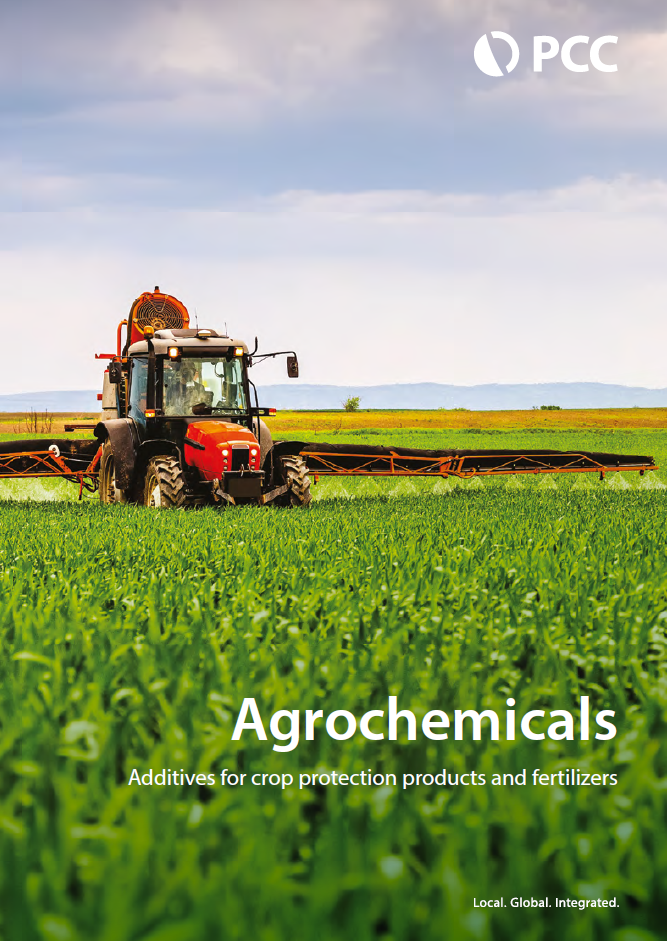
Okładka katalogu
Filters
Function
Composition
Segment
Manufacturer
of 3
ROKAnol® O20 (Oleth-20) ROKAnol® O20 belongs to the group of non-ionic surfactants of the type of ethoxylated fatty alcohols (INCI name: Oleth-20). At room temperature, the product has...
Composition
Alkoxylated alcohols
CAS No.
9004-98-2
ROKAnol® O20 (Oleth-20)
ROKAnol® GA4LA (Polyoxyalkylene glycol) ROKAnol® GA4LA is a non-ionic surfactant that belongs to the group of alkoxylated fatty alcohols based on C10- Guerbet alcohol. The commercial product is provided...
Composition
Alkoxylated alcohols
CAS No.
166736-08-9
ROKAnol® GA4LA  (Polyoxyalkylene glycol)
ROKAnol®GA8LA (Polyoxyalkylene glycol on Guerbet alcohol) ROKAnol® GA8LA is classified among the non-ionic surfactants of alkoxylated fatty alcohol type. The product co-forms a group of surfactants based on C10 Guerbeta...
Composition
Alkoxylated alcohols
CAS No.
166736-08-9
ROKAnol®GA8LA  (Polyoxyalkylene glycol on Guerbet alcohol)
ROKAnol® GA7LAW (PEG-7/PPG-2 Propylheptyl ether) ROKAnol® GA7LAW is a non-ionic surfactant from the group of ethoxylated fatty alcohols INCI PEG-7 / PPG-2 Propylheptyl ether. The product belongs to the group of...
Composition
Alkoxylated alcohols
ROKAnol® GA7LAW  (PEG-7/PPG-2 Propylheptyl ether)
ROKAnol®GA8W (C10 alcohol, ethoxylated) ROKAnol® GA8W belongs to nonionic surfactants of the type of ethoxylated fatty alcohols. The product co-creates a group of surfactants based on C10 Guerbet alcohol....
Composition
Alkoxylated alcohols, Ethoxylated alcohols
CAS No.
160875-66-1
ROKAnol®GA8W  (C10 alcohol, ethoxylated)
ROKAnol®GA9 (C10 alcohol, ethoxylated) ROKAnol® GA9 is a nonionic surfactant that belongs to the group of ethoxylated fatty alcohols. The product co-creates a group of surfactants based on C10 Guerbet...
Composition
Alkoxylated alcohols, Ethoxylated alcohols
CAS No.
160875-66-1
ROKAnol®GA9   (C10 alcohol, ethoxylated)
ROKAnol®GA9W (C10 alcohol, ethoxylated) ROKAnol® GA9W is a nonionic surfactant that belongs to the group of ethoxylated fatty alcohols. The product co-creates a group of surfactants based on C10 Guerbet...
Composition
Alkoxylated alcohols, Ethoxylated alcohols
CAS No.
160875-66-1
ROKAnol®GA9W   (C10 alcohol, ethoxylated)
ROKwinol 60 (Polysorbate 60) ROKwinol 60 is a nonionic surfactant based on natural raw material. It is an ethoxylated sorbitan monostearate derivative called INCI Polysorbate 60. The product...
Composition
Sorbitan esters
CAS No.
9005-67-8
ROKwinol 60 (Polysorbate 60)
ROKwinol 80 (Polysorbate 80) ROKwinol 80 is a nonionic surfactant based on natural raw material. It is an ethoxylated sorbitan monooleate derivative called INCI Polysorbate 80. The product can...
Composition
Sorbitan esters
CAS No.
9005-65-6
ROKwinol 80 (Polysorbate 80)
41 - 49 of 49 products
Items on page: 20

Recently, the agricultural sector has been facing challenges related to increasing productivity and resource efficiency, while reducing the environmental impact on ecosystems and human health. In this context, plant biostimulants play a key role alongside plant protection products and fertilisers.

What are the benefits of using plant biostimulants?

The main role of a biostimulant should not be fertilisation or pesticidal action. They are not classified as fertilisers, nor do they have a direct effect on pests.

Their fundamental task is to stimulate and accelerate life processes, increase plant resistance to stressful conditions and accelerate the development of roots, leaves, etc. Plant biostimulants are used to improve the biochemical, morphological and physiological processes occurring in a crop plant.

There are many groups of plant biostimulants. The most important ones are:

  • Amino acid-based,
  • Obtained from sea algae,
  • Containing humic acids,
  • Bacteria and fungi-based.

Raw materials in the production of plant biostimulants

The raw materials used in the production of plant biostimulants are extremely diverse, as the category of biostimulants itself includes many different substances of natural and microbiological origin.

Plant biostimulants can be obtained from a wide range of raw materials, including:

  • Plant extracts: Various parts of plants, such as leaves, roots and seeds, are used to extract beneficial compounds. Examples include extracts from aloe vera, moringa and alfalfa.
  • Seaweed and algae: Seaweed, especially brown and red algae, is a common source of biostimulants that improve soil health and plant growth.
  • Microbial inoculants: Beneficial bacteria, fungi, and other microorganisms are cultivated and used as biostimulants for plants.
  • Humic substances: Humic and fulvic acids, derived from decomposed organic matter, are used to increase soil fertility and nutrient availability.
  • Amino acids and proteins: These can be obtained from plant or animal sources. They are used to promote plant growth and increase their resistance to stress.
  • Compost: Organic compost and vermicompost.

Plant biostimulants can be used in the form of soil preparations (powders, granules or solutions added to the soil) or as liquid products for foliar application in dry or liquid form. Despite the leading role of these active ingredients, it is necessary to use a number of adjuvants during their formulation to ensure that they perform their tasks well.

The role of adjuvants

Natural plant biostimulants play a key role in sustainable plant production. In addition to the basic active ingredients in the formulation, adjuvants are also necessary. They determine the effectiveness, stability, ease of application and safe miscibility of the biostimulant with other agrochemicals.

The most important group of chemical compounds used to create plant biostimulant formulations are surface-active substances, also known as surfactants. These are molecules with an amphiphilic chemical structure. They have a hydrophilic and hydrophobic group, which gives them an affinity for both polar and non-polar phases.

Surfactants perform a number of important functions:

  1. When added to a base solution, they lower the surface tension, reducing the barrier between liquid and gas, another liquid or a solid. This directly contributes to a more effective distribution of the preparation on the plant.
  2. They improve the homogeneity of the mixture through better dispersion of the components.
  3. They improve wettability, which translates into more effective absorption and higher bioavailability.
  4. They act as emulsifiers by combining immiscible components. They prevent phase separation in the formulation and control its viscosity.
  5. They increase the biological effectiveness of plant biostimulants.

Among surfactants, betaines are important components of biostimulant formulations. However, they mainly act as active ingredients rather than just excipients. Compounds from the betaine group have an osmotic effect, regulating water exchange in cells and improving plant resistance to stress caused by drought, extreme temperatures or salinity. They also increase the ability of plants to photosynthesise, which leads to efficient nutrient uptake and increased production and quality. Betaine is considered one of the most effective tools for combating plant stress caused by adverse climate change.

It is worth mentioning a group of compounds used in plant biostimulants, namely polyethylene glycol (PEG) and its derivatives. PEGs increase the stability and effectiveness of active substances. They also have the ability to retain moisture – reducing excessive evaporation prolongs the absorption of nutrients.